Heinrich: BAAJA Will “Make a Big Difference in People's Energy Costs”
WASHINGTON — U.S. Senator Martin Heinrich (D-N.M.), Ranking Member of the U.S. Senate Energy and Natural Resources Committee, highlighted his Bipartisan American Affordability and Jobs Act (BAAJA), legislation to lower energy bills, hold data centers accountable, reduce emissions, and create good-paying jobs, during an interview with The Hill’s Alex Bolton.
“We can make a big difference in people's energy costs — particularly their electric bill. And there's a real desire by the American people just for us to do our jobs and produce actual results for them, and not be, you know, pulled around by the extreme voices in, in any debate,” said Heinrich.
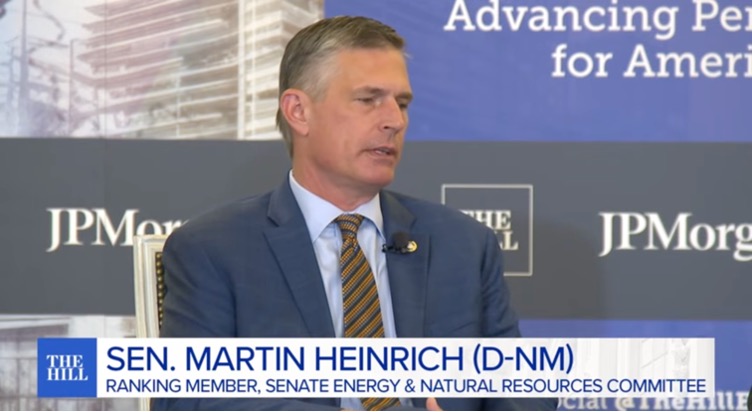
On BAAJA Lowering Energy Costs:
Alex Bolton: “I get the sense that there's real, you know, pent up demand to actually do something to pass legislation that makes an impact, and that's what we're seeing right now with these big votes.”
Senator Heinrich: “I think [there’s] just a desire to actually do things. You know, nothing's going to be perfect, but obviously the last election was prosecuted on the necessity of giving people some relief from the inflation and the higher prices that are just driving the conversation with normal Americans everywhere in the country. And this is one of the places where we can make a difference. We can make a big difference in people's energy costs, and particularly their electric bill. And there's a real desire by the American people just for us to do our jobs and produce actual results for them, and not be, you know, pulled around by the extreme voices in, in any debate.”
Bolton: “The Rhodium Group estimates the bill will reduce household electricity bills by $50 to $70 a month by the year 2040. Are you looking at that assessment? How big of an impact do you think this will have on families' energy bills over the next five to 10 years? Can you put a number on it?”
Heinrich: “I think their estimate is as good as any [estimate] I've seen. I think the principle here is that we need to put more cheap electrons onto the grid a whole lot faster, and right now we have literally almost 2,000 gigawatts of generation sitting in interconnection queues for an average of over six years, just waiting in line. That's not the permitting side of things. That's just the waiting in line to plug into the grid side of things, so we make that much faster and easier in this legislation. We make permitting faster, and so we're going to be able to put more cheap, clean electrons onto the grid, and that is the only way we're going to reverse this trend of electricity just getting more and more and more expensive.”
On Potential Amendments to BAAJA:
Bolton: “I understand there are negotiations on amendments. You're working on a manager's amendment...What changes do you think will be included in the manager's amendment? I know this requires consensus, but what do you think is most likely to be included in that amendment, or what other amendments do you think are likely to get votes before the end of the week?”
Heinrich: “There are a number of amendments around the Tribal provisions in the National Historic Preservation Act (NHPA). I think those are helpful. You know, we'll release something as soon as we can. But as you can imagine, in terms of a manager's amendment, it requires four corners agreement. And those changes will be relatively modest because it requires the chairs and ranking members of both committees.
On Heinrich's Work to Codify Tribal Consultation in BAAJA:
Heinrich: “I think one of the things that's important to recognize with the Tribal provisions in the NHPA is what our actual choices are, because this administration was moving forward on a process that would have effectively replaced Tribal consultation with a 30-day comment period. And I can't overstate how problematic that would be, because what works in consultation, having been through a lot of projects in my state that require Tribal consultation, is when an agency sits down with a Tribe, and there is an actual conversation, and that deconflicts a project away from places that are problematic, places that we want to protect historic and cultural sites and landscapes. And so, we need that to be a robust process. And one of the things I like about this legislation is that we were actually able to incorporate in the manager's package a statutory requirement for the agencies to consult at each of the steps in the NHPA, and so that's actually a big step forward. But because of where we started with the administration and the Tribes, I don't think that has fully been recognized yet. Like, what an improvement to the process that will be for Tribal governments.”
On BAAJA Expediting the Approval of Clean Energy Projects:
Bolton: “You've talked about and written about the SunZia project, the largest clean energy infrastructure project in the Western Hemisphere, in New Mexico. More than 900 wind turbines. It took 17 years to permit and build. If BAAJA becomes law, what kind of impact would it have on a project like that – in terms of how long it takes?”
Heinrich: “My guess is that project could have probably been completed in five or six years as opposed to seventeen. That's a big, big difference, and, you know, that's a project that I would argue was one of the best-designed projects because the developers actually listened. They avoided the places I warned them were, you know, were to be avoided for other values. We are a big public land state. People love their wilderness and their wilderness study areas, their refuges, and so they were very smart about how they designed the transmission route. It was a clean energy project. They came in and they actually protected a bunch of habitat in order to compensate for the impacts that building has. And yet, if you have all the boxes checked, like this is one of the best-designed projects that I've had to engage with, and it still took 17 years. You know, something's wrong. And biggest project labor agreement in the history of the Southwest, $20 billion worth of economic impact to the states of New Mexico and Arizona. We should be able to get to yes for a good project in a reasonable amount of time. We should be able to get to no for a poorly designed project. And if you're going to get to no, let's fail fast and then move on to a better project.”
On Heinrich’s Priorities as the Incoming Chairman of the U.S. Senate Energy and Natural Resources Committee:
Bolton: “With a new Democratic majority coming in, what changes do you want to further empower committees? Because I think the lesson from this is that when you empower the committees and you empower the Chairman, there's bipartisanship and things get done. How do you take that lesson going forward into the next Congress?
Heinrich: “I think we do better work when committees are empowered, and so one of the things I want from leadership on both sides is to let their Chairman negotiate and get to actual good legislation. I think the more power that is pushed down to the committees, who have the most knowledge of how to come up with a good product, the more that benefits our ability to produce a better product.”
###